


Laptops were designed to be portable, not to be used for eight hours a day at a kitchen table. The problem is simple: on a laptop the screen and the keyboard are joined together. If the keyboard is at a comfortable height, the screen is too low and your head tilts forward. If you raise the screen to eye level, the keyboard ends up too high for your arms. Many remote workers live with that compromise for months without noticing how much it shapes their posture.
This guide explains how to turn a laptop into a comfortable workstation, step by step: what to buy first, how to set the screen, keyboard, mouse and chair, how to work when you are away from your desk, and which habits keep you comfortable through the day.
Why laptop posture goes wrong
When you look down at a screen that sits on the desk, your neck bends forward and your shoulders tend to round. Your wrists often rest on the sharp front edge of the laptop, and because the trackpad is small and centred, your hands stay close together for hours. None of this feels bad in the first ten minutes, which is exactly why it becomes a habit.
The UK Health and Safety Executive, in its guidance on good posture with display screen equipment, summarises the fix for prolonged laptop use in two points: use a keyboard and mouse that are separate from the laptop so the screen can be raised on a riser, or use a display screen separate from the laptop. Everything else in this guide builds on that idea.
The three pieces that change everything
You do not need an expensive setup. Three affordable items solve most laptop problems:
- A laptop stand or riser. It lifts the screen toward eye level. Adjustable aluminium stands, folding stands for travel and simple fixed risers all work. A sturdy stack of books is a perfectly good temporary solution.
- An external keyboard. Once the laptop is raised, its own keyboard is out of reach, so you type on a separate one placed on the desk. Compact keyboards without a number pad keep the mouse closer to your body.
- An external mouse. It lets your arm rest in a natural position beside the keyboard instead of reaching to a trackpad in the middle.
If you also have an external monitor, you can either use it as your main screen and keep the laptop closed, or put the laptop on the stand next to it as a second display. Our guides to monitor height and keyboard positioning go deeper on each item.
Setting up the workstation step by step
Follow this order, because each step affects the next.
1. Start with the chair
Adjust the seat height so your feet rest flat on the floor, or on a footrest, and your thighs are roughly level. The HSE suggests leaving a small gap of 2 to 3 cm between the front of the seat and the back of your knee, and making sure the backrest gives good support to your lower back. A rolled towel or small cushion can add lower back support if your chair has none.
2. Place the keyboard and mouse
Put the external keyboard directly in front of you, at or just below elbow height, so your shoulders can relax without shrugging. Keep the mouse right beside the keyboard, in line with your elbow, so you do not reach sideways. Your wrists should stay fairly straight while you type rather than bent up or down.
3. Raise the screen
Set the laptop on the stand directly in front of you, behind the keyboard. The HSE recommends having the top of the screen roughly level with your eyes and about an arm’s length away. Tilt the screen slightly back so you look at it without craning your neck. If you wear bifocal or progressive glasses, a slightly lower screen is often more comfortable, because you look through the lower part of the lens.
4. Check alignment and light
Your screen and keyboard should be centred with your body so you do not twist to work. Position the desk so windows are to the side of the screen instead of directly behind or in front of it, which reduces glare. Increase the text size in your operating system if you notice yourself leaning in to read.
5. Do a two-minute comfort test
Type a paragraph, scroll a long page and join a short video call. Notice whether your shoulders rise, your neck bends forward or your wrists press on an edge. Adjust one thing at a time until nothing pulls.
Working away from the desk
Laptops exist so you can move, and sometimes you will work from a sofa, a café or a hotel room. You cannot make those places perfect, but you can make them better:
- Carry a folding stand and a small keyboard. Together they weigh little and fit in most bags.
- On a sofa, sit back with your lower back supported by a cushion and raise the laptop on a lap desk or a firm pillow rather than resting it flat on your knees.
- In a café, choose a table and chair over a low lounge seat, and keep sessions short.
- In bed, limit work to quick tasks. Lying on your stomach or propping the laptop on your chest puts the neck and wrists in awkward positions quickly.
The more improvised the setup, the more often you should stand up and change position.
Habits that matter as much as the equipment
Even a perfect workstation becomes uncomfortable if you hold one position all day. Movement is part of good ergonomics. The HSE’s advice on work routine and breaks notes that short, frequent breaks are better than longer, occasional ones; for example, 5 to 10 minutes every hour is better than 20 minutes every two hours. Breaks should let you get up, move around, or at least stretch and change posture.
Practical ways to build that into a remote workday:
- Take phone calls standing or walking.
- Refill your water glass in another room instead of keeping a bottle on the desk.
- Use a gentle timer or calendar block as a reminder, especially during focused work.
- Look away from the screen at something far away from time to time to rest your eyes.
- Change between sitting and standing during the day if you have an adjustable desk.
If you notice persistent pain, numbness or tingling, do not try to solve it only with equipment. Talk to a doctor or a qualified health professional, and mention how many hours you work at the computer.
Common mistakes to avoid
- Raising the laptop on a stand but still typing on its built-in keyboard, which pushes your arms and shoulders up.
- Placing the external keyboard so far away that you lean forward to reach it.
- Putting the screen off to one side, so your neck stays rotated for hours.
- Using a chair with no lower back support and sitting on the front edge of the seat.
- Buying many gadgets before fixing the basics of chair, screen height and keyboard position.
- Working for hours without standing up because the setup now “feels fine”.
Summary
The core problem with laptops is that the screen and keyboard are attached, so you cannot set both at the right height. Separate them: raise the laptop on a stand or riser, and use an external keyboard and mouse at about elbow height. Adjust the chair first, then the keyboard and mouse, then the screen, with its top roughly at eye level and about an arm’s length away. Away from the desk, a folding stand and a compact keyboard go a long way. Finally, treat movement as part of the setup: short, regular breaks and changes of position keep you comfortable long after the right equipment is in place.
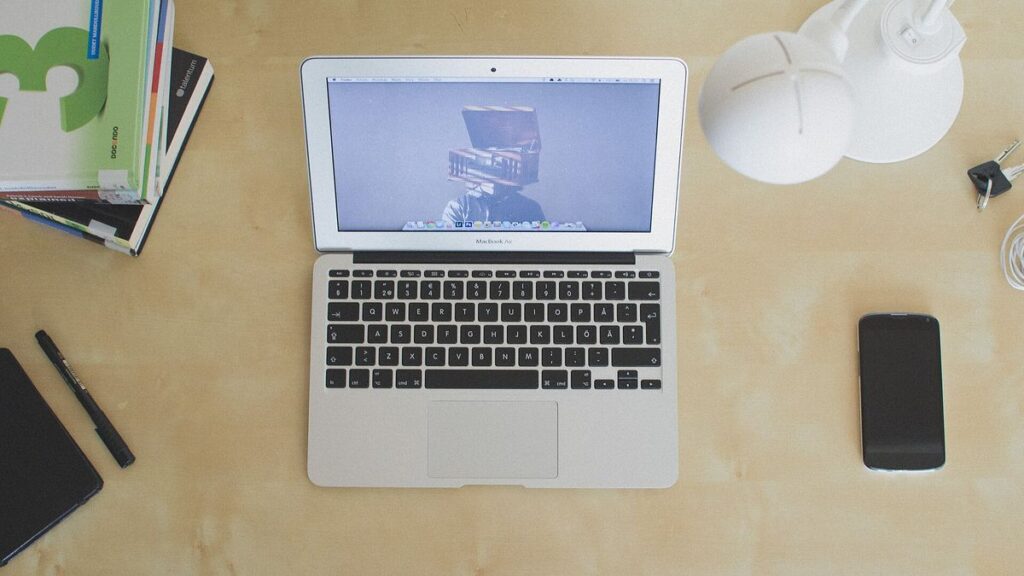
Photo: Laptop on a desk (Unsplash), by Aleksi Tappura a, license CC0, via Wikimedia Commons. Cropped.